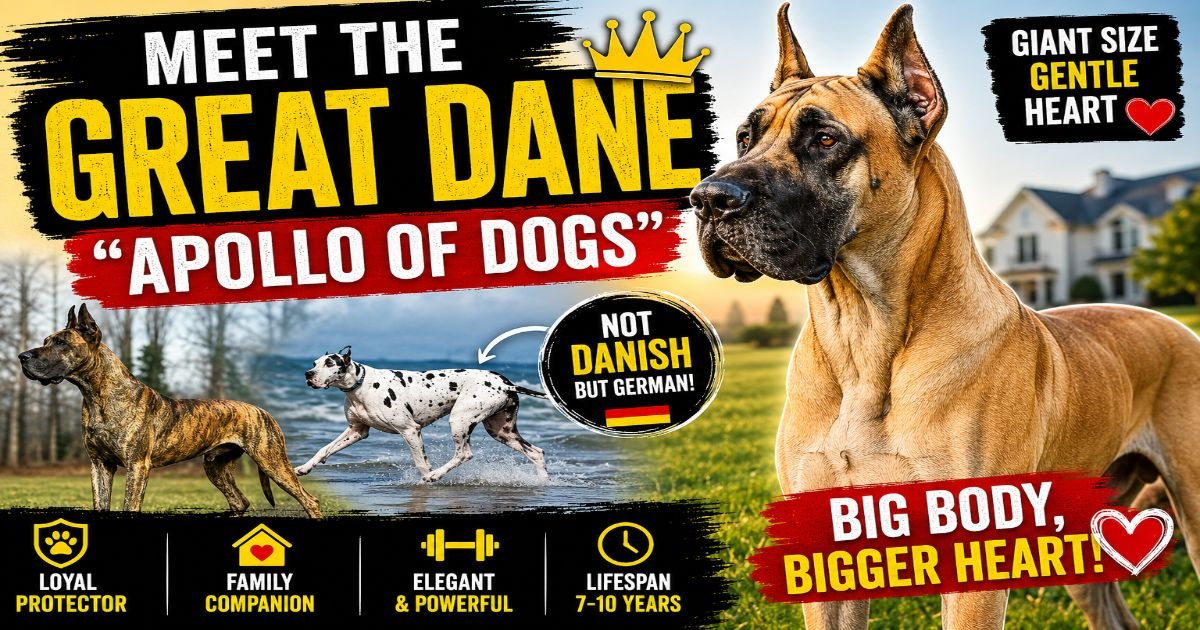
Great Dane: The Giant Dog With a Surprisingly Gentle Side
At first glance, a Great Dane can look almost too big to be a house pet.
Standing up to 32 inches tall at the shoulder, this giant breed can weigh as much as 175 pounds. Yet behind that huge body is a dog that is often friendly, patient, affectionate, and surprisingly calm.
That contrast is what makes the Great Dane so fascinating.
Known as the “Apollo of Dogs,” the Great Dane has the kind of appearance that can stop people during a walk. But its story is much more interesting than its size.
The Great Dane Isn’t Actually From Denmark
Here is one of the most surprising facts about this breed: the Great Dane is not Danish.
The modern breed was developed in Germany, where it was known as the Deutsche Dogge, or German dog. Its ancestors were used as powerful hunting dogs, including for hunting wild boar.
So why is it called a “Great Dane”?
The exact reason remains unclear. The name became associated with the breed through European languages, even though the breed’s development is strongly connected to Germany.
A Hunting Dog That Became a Family Companion
It is hard to imagine a modern Great Dane chasing a wild boar.
Today, many Danes are more interested in following their owners from room to room, lying beside the family, or simply finding a comfortable place to relax.
But that old hunting instinct has not completely disappeared.
Great Danes can still become very interested in an interesting smell. That is why secure fencing and leash control are important when they are outside.
The Giant Dog That May Think It Is a Lap Dog
One of the funniest things about living with a Great Dane is that the dog may not understand just how large it is.
A 150-pound dog can still want to sit next to you like a tiny puppy.
Great Danes are known for enjoying human company and forming strong bonds with their families. Their size can make them look intimidating, but their personality is often much softer than their appearance suggests.
For many owners, that is the real magic of the breed.
You see a giant dog. They see their best friend.
Their Size Is Beautiful — But It Comes With Responsibility
Owning a Great Dane is not simply about having a bigger dog bed.
Everything can become bigger.
Food bills, crates, collars, beds, transportation, veterinary care, and even the amount of space needed around the home can be greater than with a smaller breed.
Training is also especially important. A poorly trained small dog can be difficult. A poorly trained 150-pound dog can be a serious problem.
The good news is that Great Danes are generally eager to please, and early socialization and consistent training can help them become well-mannered companions.
They Don’t Need to Run All Day
Another common misconception is that a giant dog must have endless energy.
Great Danes do need daily exercise, but they are not necessarily nonstop athletes.
For many adult Danes, regular walks and appropriate activity can be enough. However, young Great Danes need special care because their bodies grow rapidly. AKC recommends waiting until around age two before regular jogging or strenuous running to help protect developing joints.
That means the perfect Great Dane lifestyle may look less like a marathon runner and more like:
Walk. Explore. Eat. Nap. Repeat.
The Hard Truth: Their Lives Are Often Too Short
There is one part of Great Dane ownership that every potential owner should understand.
These dogs are enormous, but their average lifespan is relatively short.
AKC lists a typical life expectancy of about 7–10 years, while some Danes may live longer. Giant breeds generally have shorter lifespans than many smaller dogs.
Great Danes are also at particular risk for serious health problems, including bloat (gastric dilatation-volvulus). Owners should learn the warning signs and discuss prevention and emergency planning with their veterinarian.
This is perhaps the most important lesson of the breed:
With a Great Dane, the years may be fewer — so the moments matter even more.
Why Do People Fall in Love With Great Danes?
Maybe it is the size.
Maybe it is the elegant walk.
Maybe it is the funny combination of a giant body and a gentle personality.
Or maybe it is the way a Great Dane can make an ordinary walk around the neighborhood feel like a small parade.
The breed combines strength, elegance, affection, and a fascinating history. It was once developed for a dangerous job, but today it is best known as a loyal companion and family dog.
And that may be the biggest surprise of all.
The Great Dane may look like a dog built for battle — but many of them simply want to be close to their people.
Great Dane Quick Facts
- Nickname: “Apollo of Dogs”
- Origin: Germany
- Male height: 30–32 inches
- Male weight: 140–175 pounds
- Female height: 28–30 inches
- Female weight: 110–140 pounds
- Typical lifespan: 7–10 years
- Coat: Short and smooth
- Popular pattern: Harlequin
- Personality: Friendly, patient and dependable
- Important consideration: Giant size means higher care, training and veterinary responsibilities
Final Thought
The Great Dane teaches us something interesting about dogs.
Never judge a dog by its size.
Behind one of the biggest dog bodies in the world can be a gentle, affectionate companion that simply wants to share your home, your walks, and your everyday life.
That is why, for many Great Dane owners, the biggest dog in the house can also become the biggest personality in the family.