UK school
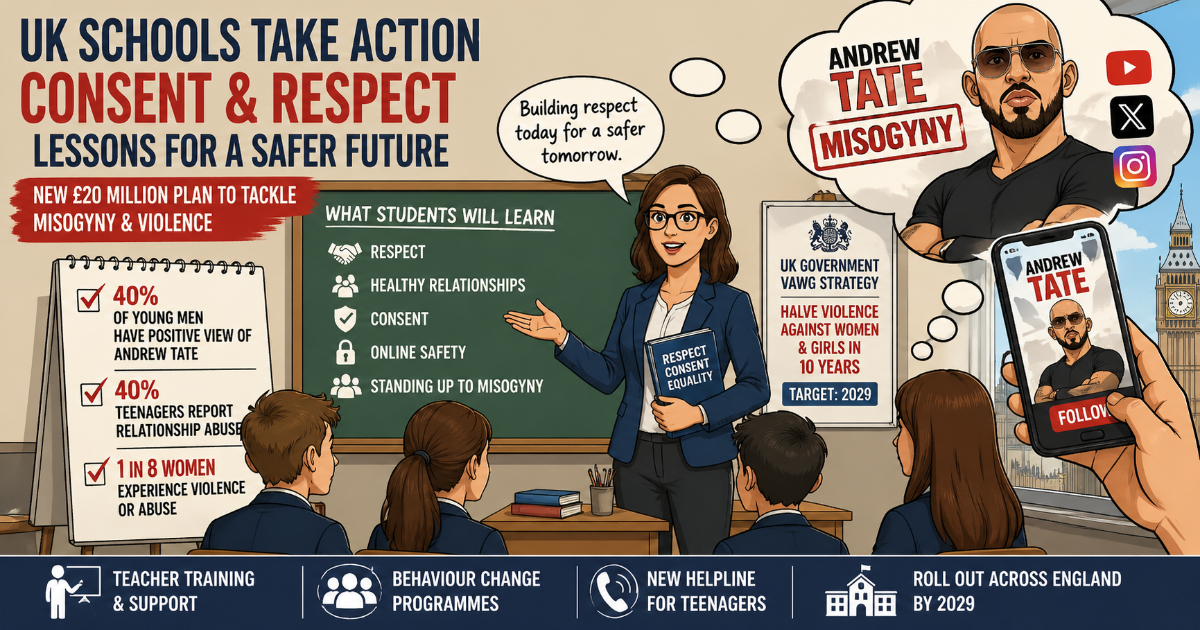
In December 2025, the UK government led by Prime Minister Keir Starmer unveiled a £20 million education strategy aimed at tackling rising concerns around misogyny and youth attitudes toward relationships. The plan, part of the national Violence Against Women and Girls (VAWG) strategy, will introduce mandatory lessons in all secondary schools across England focused on respect, consent, and healthy relationships.
The move comes after alarming statistics revealed that over 40% of young UK men hold a positive view of Andrew Tate, a controversial online figure often criticized for promoting misogynistic views. At the same time, nearly 40% of teenagers in relationships report experiencing abuse, highlighting a growing social issue that policymakers say must be addressed early.
Teachers will receive specialized training on topics such as online behavior, consent, and intimate-image abuse. Students showing harmful behavior will be guided into behavior-change programs, while a new helpline will offer confidential support for teenagers concerned about their own actions.
The government aims to reduce violence against women and girls by 50% within the next decade, calling the issue a “national emergency.” However, critics including Kemi Badenoch argue the funding is insufficient and question the approach, suggesting broader cultural factors should be addressed.
Supporters of the plan insist that early education is key, emphasizing that changing attitudes during adolescence is the most effective way to prevent future violence and build healthier relationships.
Disclaimer
This article is intended for informational and educational purposes only. The content is based on publicly available reports, government statements, and media sources at the time of writing. It does not intend to promote, endorse, or defame any individual, including Andrew Tate, or any organization mentioned.
The statistics and policies discussed relate to broader social issues, including education, consent, and violence prevention, and are presented to inform public understanding. Readers are encouraged to verify information from official government sources and conduct their own research.
Any opinions expressed are general interpretations of the topic and do not represent legal, professional, or policy advice. The publisher is not responsible for any actions taken based on the information provided in this article.